

At The Barista League, we believe sustainability shouldn’t be an afterthought or a box we arbitrarily check. One of our core values is for all our activities to be as sustainable as possible for the environment, the local community, our staff and anyone or anything impacted by the work we do. We work hard to reduce our impact from the very beginning of planning our events – from the ideas stage through to post-production.
While we have a long way to go to reach our goal of being net neutral, we are committed to thoroughly recording and reviewing our impacts at each event in order to hold ourselves accountable and set a standard for future projects. From there, we can make better informed decisions when planning and delivering events all over the world.
In most cases, making more sustainable choices means pushing against the status quo and putting in a little extra effort. We don’t believe that means sacrificing experience. Who really wants to drink out of plastic cups, anyway? To us, the effort we put in is worth it. And by showing that we can do it, we hope to set a positive example for anyone else planning to produce (or even attend) an event.
This report includes data from:
1. High Density 2021
2. The Barista League: Copenhagen
3. Make Haste Not Waste (Frankfurt Coffee Festival Party)
4. The Barista League: Barcelona
5. The Barista League: Manchester
Our approach to measuring our impact on the environment is primarily production-focused. This means we measure everything that would not have occurred if we didn’t produce the event, including the transport and freight of all people and goods to the event and the resources used during the event. These numbers don’t reflect the emissions created by the production of input materials, except in the case of single use items like food and alcohol.
As of 2021, we have also not accounted for the environmental impact of each of our staff working remotely, nor our small office in Gothenburg, Sweden.
WASTE
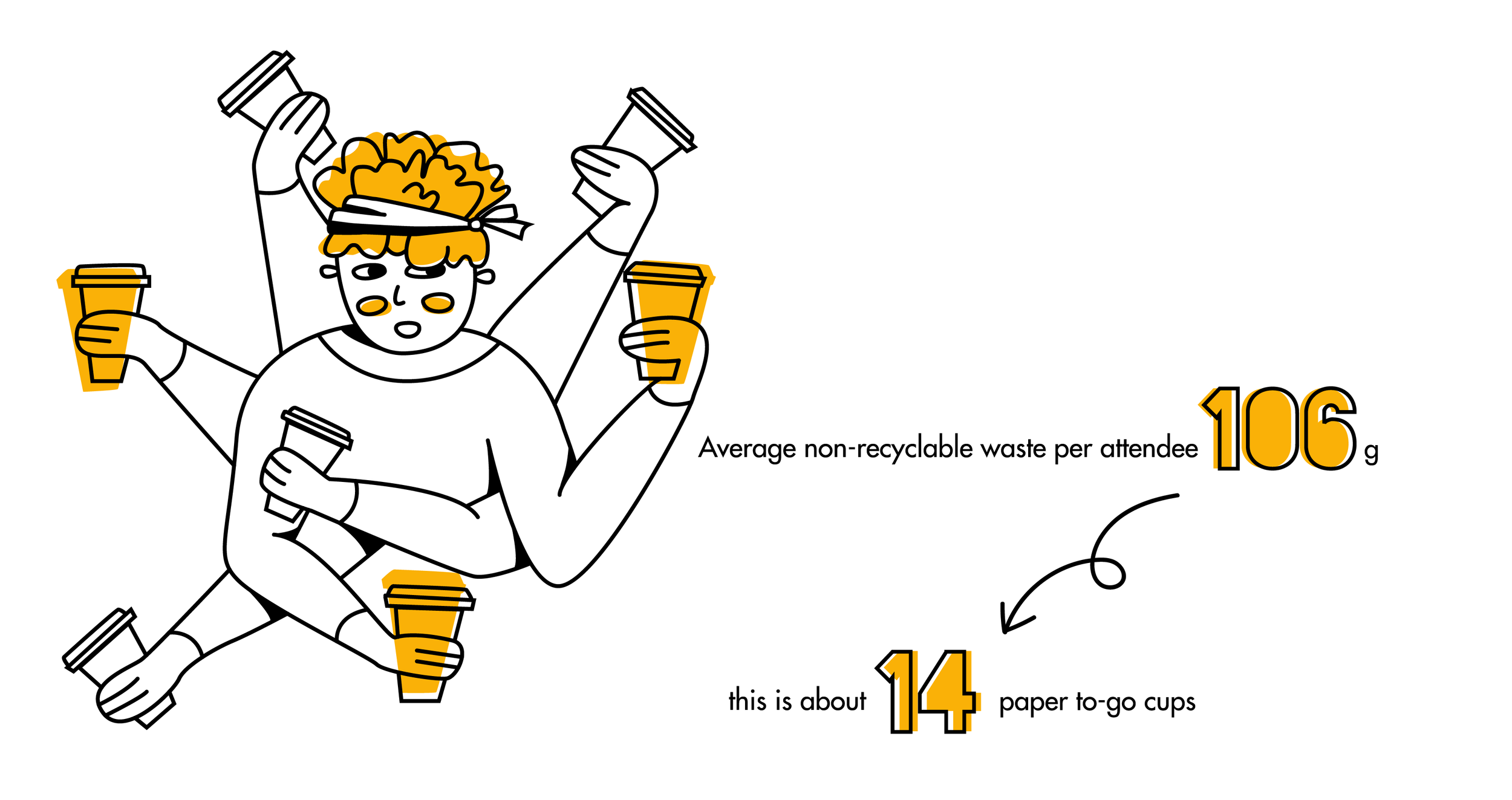
This year, we have taken a simple approach to waste at our events – ‘If there isn’t anything at the event to throw in the trash, there won't be as much trash’. By working hard to eliminate single use items and excessive packaging and considering all materials that will be used by participants, we have managed to drastically reduce our waste.
This means integrating re-usable cups and glasses, kegs instead of bottles (or using a refundable bottle systems), digital scoresheets instead of paper, and ensuring all other packaging (like oat milk or coffee bags) are recyclable. We are beholden to each host city’s recycling capacity, meaning that it is very hard for us to replicate the level of recycling we can achieve from place to place.
Our Next Steps:
1. Address the amount of packaging used to ship products to events.
2. Reduce unnecessary SWAG and comparable products at events.
3. Work with partners and suppliers to reduce upstream environmental impacts.
4. Source private recycling companies when not readily available in the city.
5. Eliminate single use products at events when possible.
FOOD & DRINK
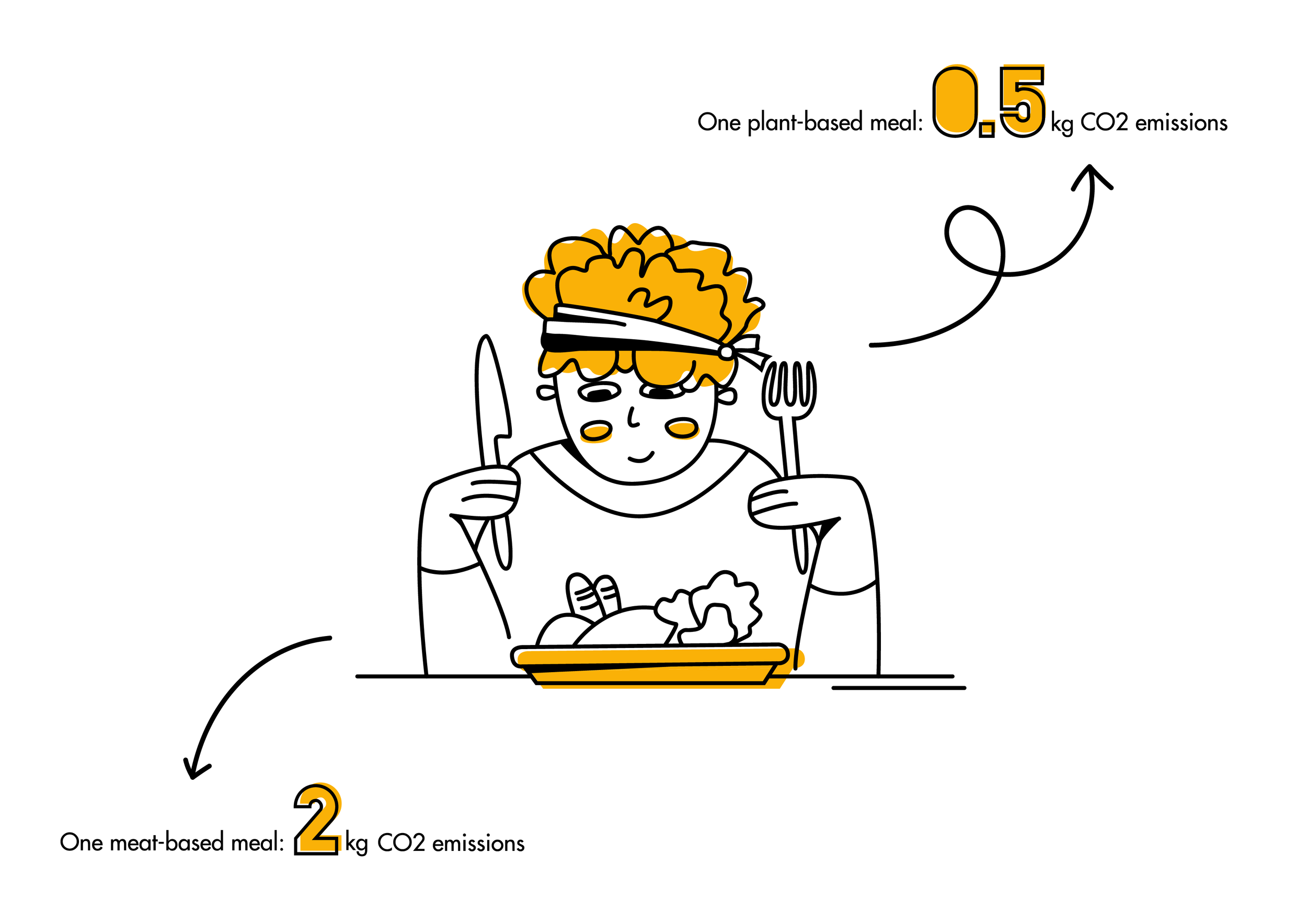
After producing our first Environmental Impact Statement in 2019, we learned that serving all plant-based meals is one of the easiest ways for us to reduce the carbon emissions at our events. There are so many delicious vegetarian and vegan food options readily available and, as a bonus, providing plant-based meals is accommodating of a larger number of guests. In 2021, three of our four physical events were totally vegan. This, combined with our choice of alternative milk drinks instead of dairy, reduced our carbon imprint by over 450 kg C02.
Our Next Steps:
1. Better estimate quantities of needed food and plant-based drinks in order to reduce waste.
2. Commit to 100% vegan or vegetarian events in 2022.
3. Find even better, lower carbon impact catering companies.
4. Ensure we have re-usable dining solutions (cutlery and plates) at all events.
5. Implement more thorough food-waste recycling systems.
WATER
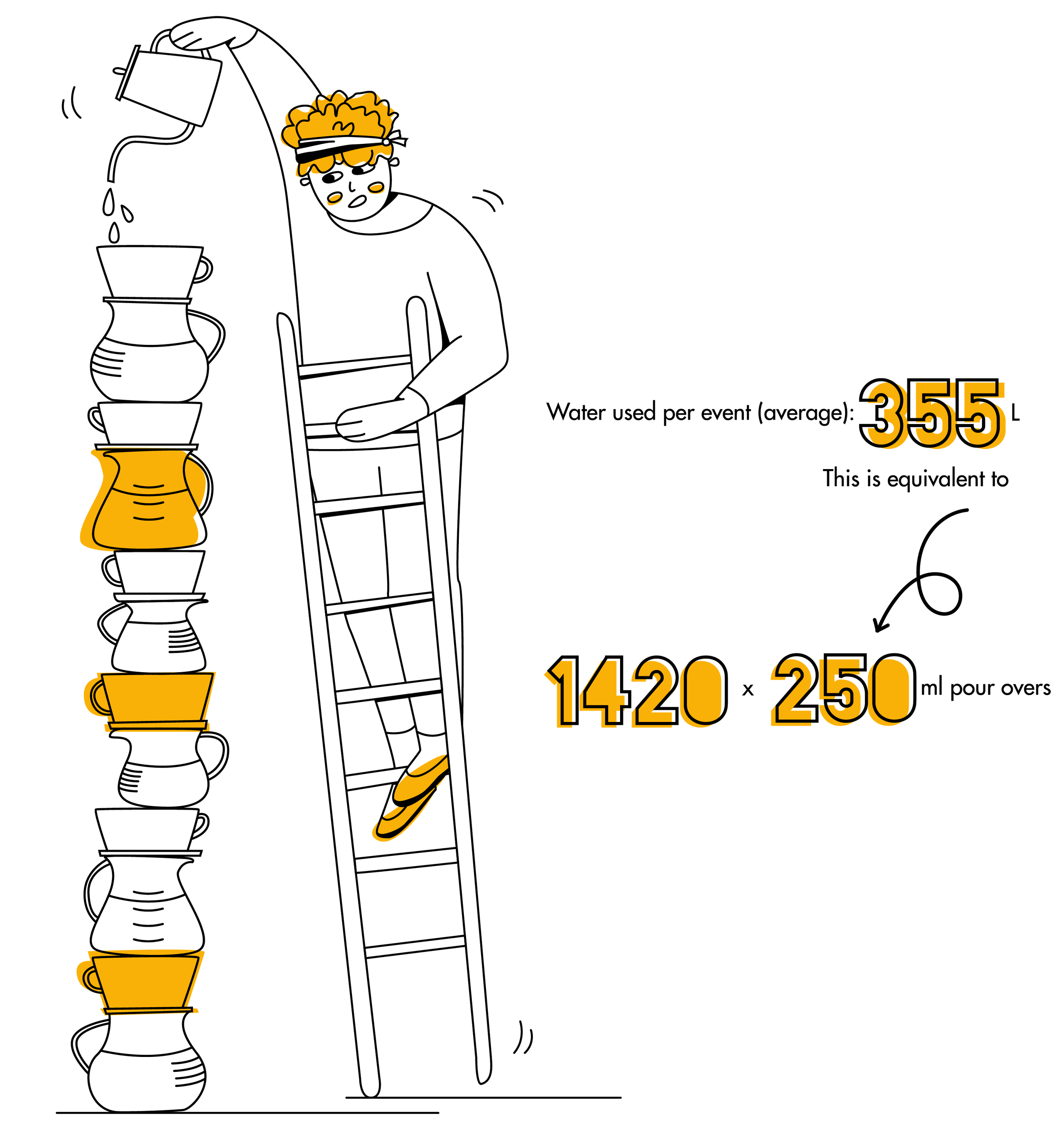
Accounting for all drinking water, toilets, and coffee prep, the number above works out to be roughly 2.3L per participant at each event – which we consider quite reasonable. A specific focus of ours has been on reducing unnecessary waste of heated water, which has been shown to have the largest impact across the coffee production cycle. We do this by limiting training time and access to ceramics which encourages a more thoughtful use of resources. When possible, we also use single serve options for coffee (like the Poursteady automatic brewer) instead of brewing in batches that might go to waste.
Our Next Steps:
1. Reduce unnecessary filling of water containers for espresso machines
2. More comprehensive measurement of all water inputs into the event
ELECTRICITY
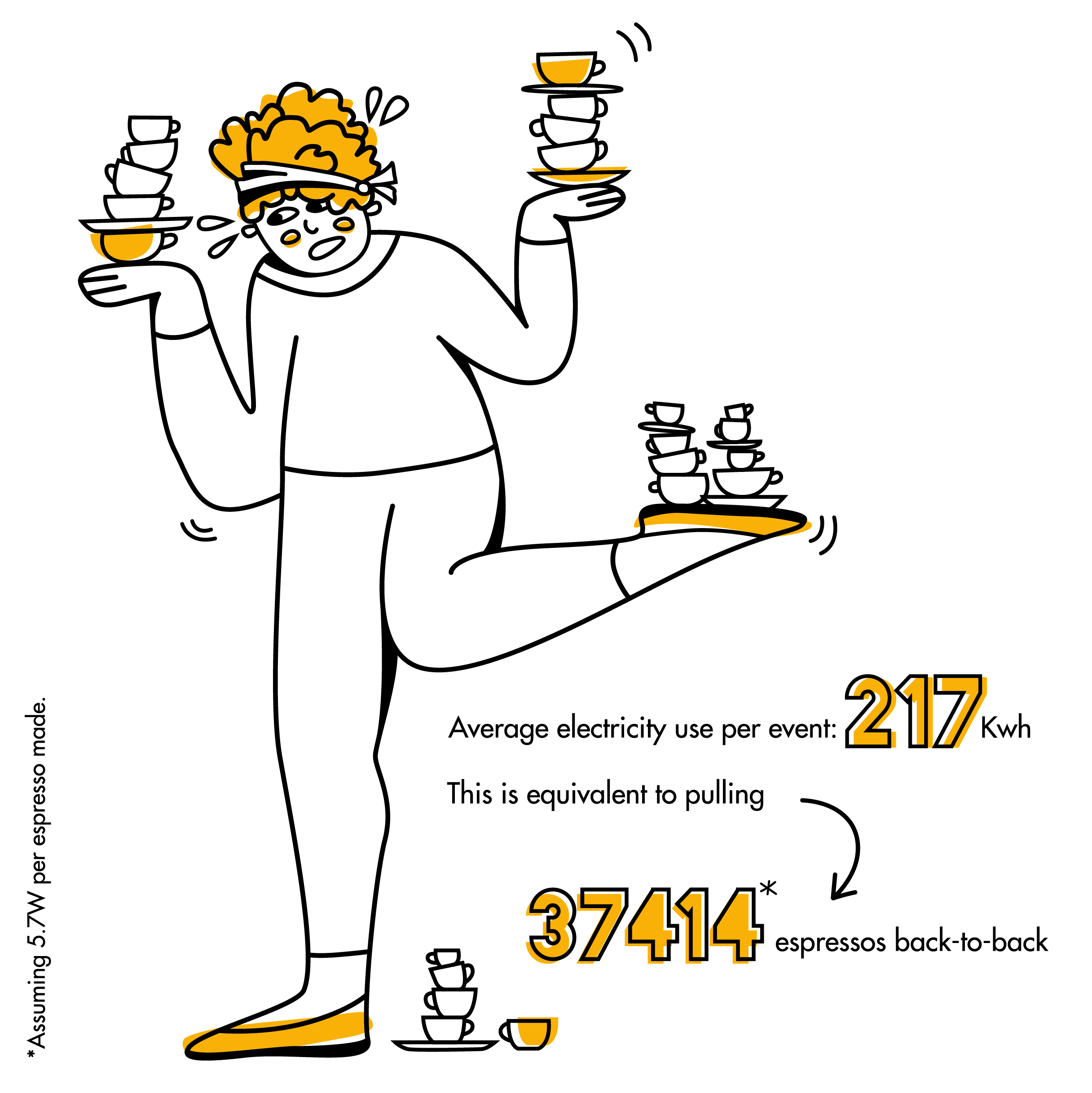
Being a relatively short event with only a few major draws on power, our usage should be incredibly low. By using LED lighting and solid-state sound systems, the major draw on power is the heating of water for the preparation of coffee – espresso machines, kettles, boilers and brewers. Once installed, we ensure that all equipment is turned off when not in use and try to reduce any unnecessary flushing, brewing or other wasteful practices. At The Barista League: Manchester, heaters were used inside the venue which quadrupled our energy use. This is something we hadn’t encountered before, but we are now acutely aware of for future events.
Our Next Steps:
1. Work harder to ensure that there is no wasteful purging, steaming, brewing, etc.
2. Ensure that all machines and other electronic equipment is only turned on when in use.
3. Work to find less power-dependent methods for heating venues when necessary.
TRAVEL
Travel (internal and external) accounts for over half of our total carbon emissions. Flights are incredibly carbon heavy and one of the core roadblocks to a more sustainable event industry. Internally, we have managed to drastically reduce our pre-pandemic impact in a few significant ways. Firstly, when possible, we travel to events by train or car (when it is possible to carpool). Secondly, we have spent a large amount of time building an infrastructure with local Project Managers for different regions that we operate in. Our team has different Project Managers and staff for European and North American-based events, reducing the need for intercontinental travel. Using local contractors, staff and Project Managers is a core part of our plan to build more sustainable and locally-tailored events for each community we visit.
While we can’t mandate how someone outside our team travels to our events, we can encourage more sustainable transport methods by providing earth-friendly suggestions of how to get to and from each venue, and even encourage carbon off-setting travel when purchasing tickets for the event.

Our Next Steps:
1. Avoid air travel – prioritize train, bus and carpooling as much as possible.
2. When air travel is necessary, avoid layovers and circuitous routes.
3. Focus on promoting events locally to each city’s coffee community.
4. Use local Project Managers for each region, reducing need for intercontinental travel.
5. Climate compensate for all emissions in 2022.
FREIGHT
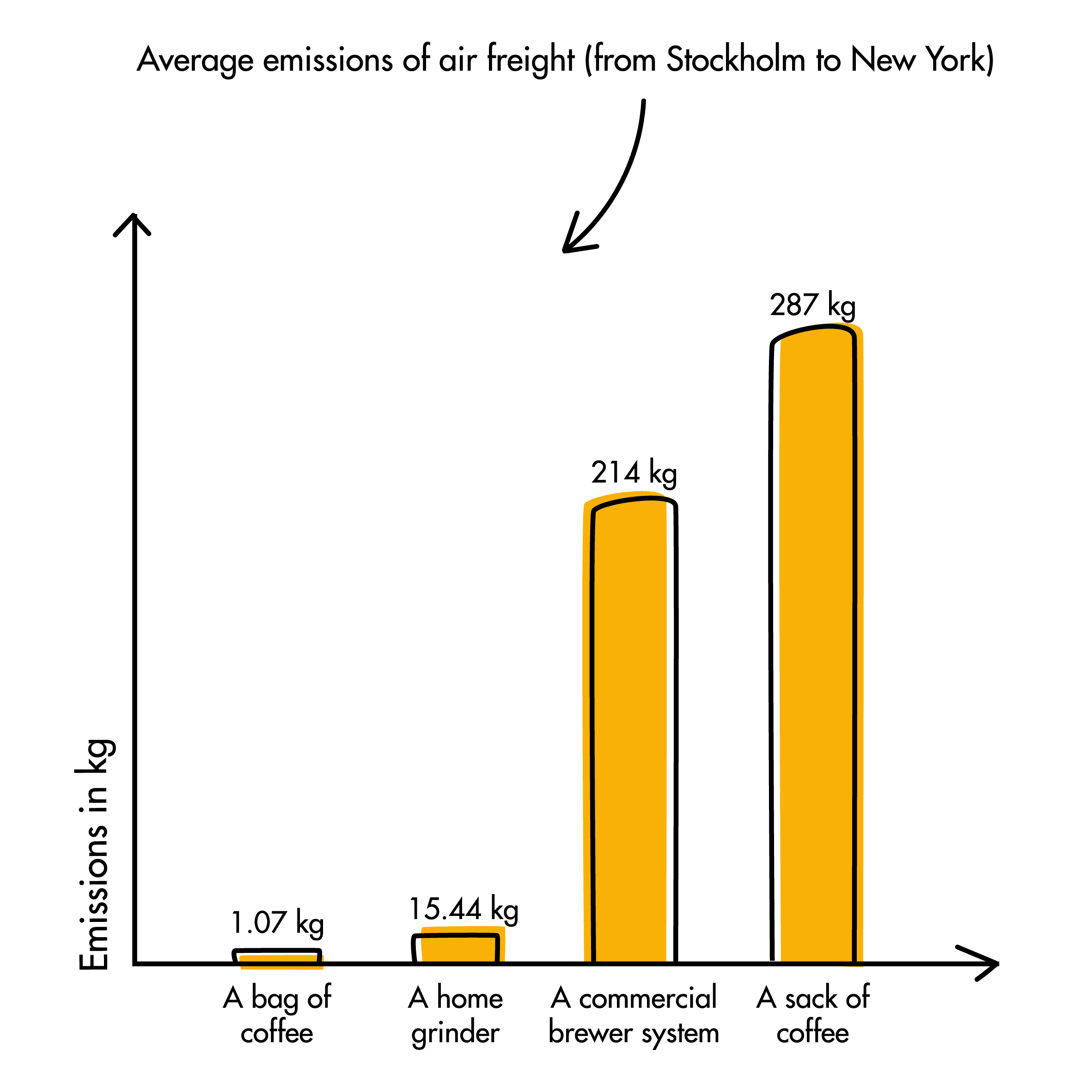
Freight, being dependant on road and air transport, is another major source of impact for us. From the beginning, we have tried to be conscious of reducing the number of materials needed for events and to use these materials as efficiently as possible.
One example of how we do this is our partnership with Baratza. Baratza supplies a number of Virtuoso+ grinders for use in the competition that are then distributed as prizes for our winning teams. Not only do these grinders make amazing prizes for our teams, but also negates onward shipping of items we need in order to run the competition.
Looking forward, we are working on ways to consolidate freight, especially with our long-term partners who are shipping products to multiple events. We are also working with more and more local partners which not only reduces the number of items shipped globally, but also has the added benefits of involving more local coffee people in the event.
Our Next Steps:
1. Consolidate shipments to reduce the number of packages shipped to each event.
2. In combination with the above, we plan to create an event kit that can be shipped from event to event like a touring kit – which will reduce shipments, packaging, and overall consumption of products.
3. Work with partners to streamline processes and use more environmentally sustainable packaging.
4. Measure and compensate for all C02 emissions caused by freight
THE HOW
We are definitely not perfect and always want to keep improving – so if you came here to sneak a peek at our dirty laundry and see the mistakes we made throughout the year, we’re totally here for that and hope the above scratches your itch. We do, however, spend a bit of time trying to reduce our impact. So, if you are a budding event manager or thinking about your own environmental impact, we have put together a few of our biggest 2021 environmental wins in the form of tips for you.
Reduce waste BEFORE it happens.
Before you procure anything, ask yourself if it will end up in the trash at the end of the night and if there is a way to avoid that. If you do this, you will drastically reduce your overall waste.
Go Vedge!
Choosing plant-based food and beverages can reduce your carbon impact by 2-4x with a single decision. If you can’t find some delicious vegetarian and vegan caterers, you’re not looking hard enough.
Make it EASY
Most people want to recycle and will if it's easy. If your hands are full, you’re in the middle of a conversation or running late for your competition slot, then you’re most likely going to toss your waste in the first bin you see – even if it’s not the appropriate one. Ensuring that each trash station is visible with clearly marked bins for each recyclable item goes a long way – even if there are fewer of them.
Change the Rules
No one ever said that competitors need to dial in using 5kg of coffee. One might even call that wasteful (or, dare we say, lacking skill.) Reduce the number of materials available and see what a really skilled barista can do with what you give them.
Take the train – seriously.
Taking a train 500km instead of a flight uses approximately 0,00045% of the C02.
Drop single-use.
Just as an example, us hospitality folks love a good paper towel. If we are honest with ourselves, though, it's pure laziness. Investing in some cloths once can totally eliminate a whole stream of waste. We even printed some fun branded cloths that we take to our events that double as fun waste-free SWAG.
THE DATA
If you want to see the raw data we collected for each event, you can see it HERE.